

When thinking of Phu Quoc, most people immediately imagine smooth white sand beaches or luxurious 5-star resorts. But if you enjoy active outdoors and want a truly different perspective—where mountains, forest, and sea meet in raw nature—then Da Bac Peak is made just for you.
With over 6 years of operating tours and directly guiding many groups through the island forest, I will share the most practical, firsthand experience for this trekking route. This guide covers everything in detail from difficulty level and route finding to “life-saving” safety warnings when chasing two stunning viewpoints on the summit.
Background & Why You Should Choose to Hike Da Bac Mountain Phu Quoc
Many travelers who reach out to me often complain: “Visiting Phu Quoc during peak season is so crowded, everywhere on the beach is packed with people. Is there anywhere that is pristine, free of charge, and good for a workout?”
Clearly, not everyone likes tourist crowds. While Conquering Nui Chua Phu Quoc requires endurance and a lot of time, and Tien Son Peak Phu Quoc has become familiar, Da Bac Mountain Phu Quoc emerges as a perfect fit. The trail is not too long but filled with challenges due to steep inclines, and the reward is majestic inland nature that few get the chance to admire.
Da Bac Mountain Trekking Specifications & Difficulty
To help you picture the trip and assess your own fitness before packing your backpack, we have summarized the core specs below:
| Core Specs | Actual Details |
| Location | Ấp Đá Bạc, eastern side of Phu Quoc Island (~15 km from Duong Dong town) |
| Altitude Coordinates | Lower than Nui Chua & Tien Son Peak, but with steeper terrain |
| Trekking Difficulty | Moderate – requires endurance and caution |
| Travel Time | 2 – 3 hours round trip (about 1h – 1h30m to reach the peak) |
| Entrance Fee | Free (no ticket required) |
| Tour Guide | Not mandatory, but having a local guide is highly recommended |
| Ideal Time | Dry season (November to May of the following year) |
Local perspective: Do not let the “2-3 hours” spec fool you into thinking this is a walk in the park! The trail to Da Bac Peak has steep climbs that drain your energy extremely fast if you do not pace your breathing properly.
Da Bac Mountain Trekking Trail: Detailed Route Guide & Experience
1. Where is Da Bac Mountain Phu Quoc & How to reach the trailhead
Located in Ấp Đá Bạc, on the eastern slope of the Pearl Island, the trailhead is about 15 km from central Duong Dong town. You can rent a motorbike and travel east. The road leading to the trailhead area is fairly easy to ride, and you can park your bike at a local home around Ấp Đá Bạc (politely ask and leave them a small tip for coffee/parking).
2. Experiencing the primeval forest canopy
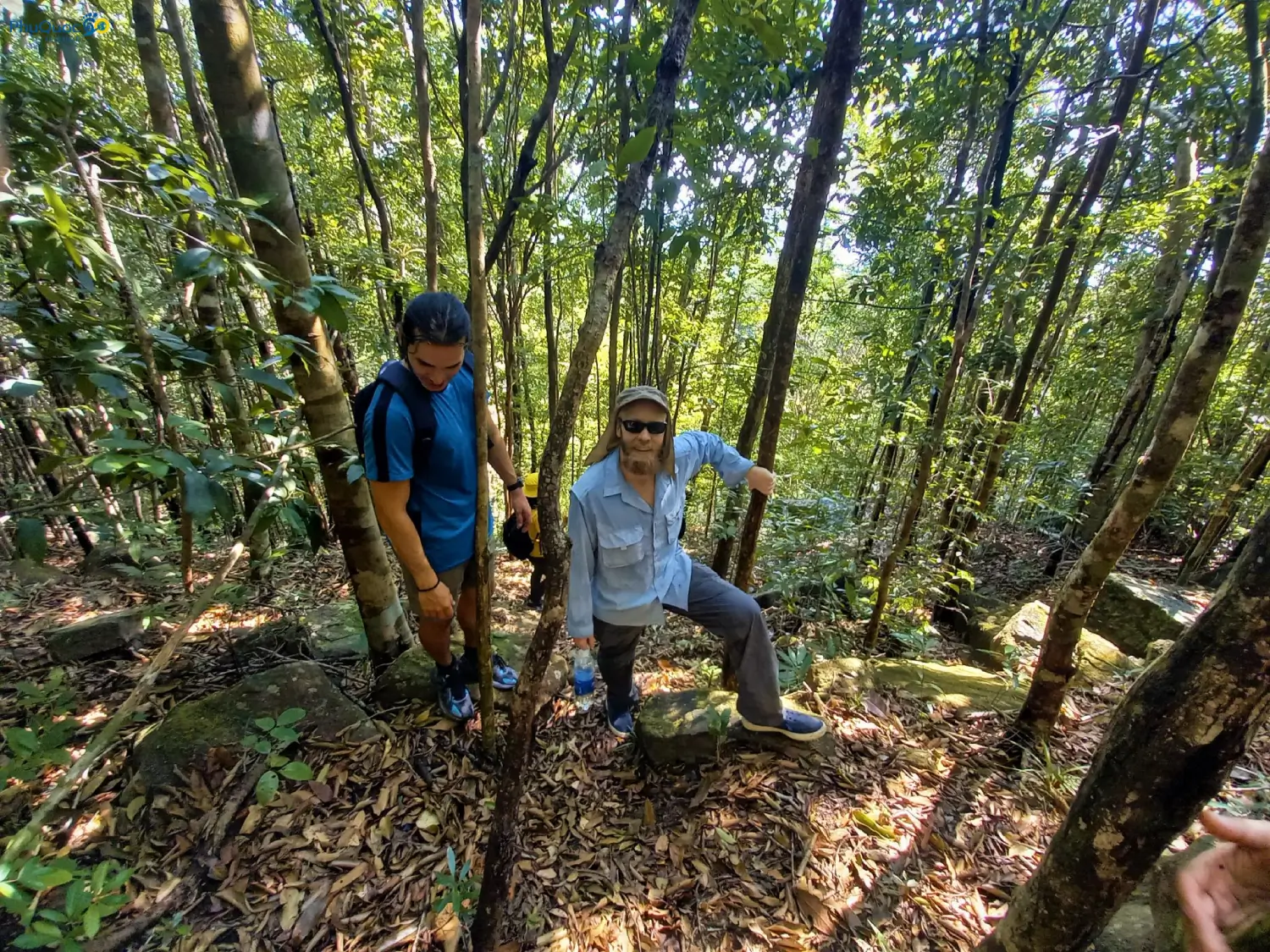
Starting the trail, you will follow an existing worn path. The air immediately turns cool thanks to the dense vegetation typical of the Phu Quoc primeval forest.
The tree trunks here are mostly small and thin, but tangled climbing vines web across everywhere, making you feel like you are stepping into a giant spiderweb in the jungle. The ground is covered in rotting leaves, rugged tree roots stick up, and scattered rocks line both sides of the path.
3. Facing steep slopes & Holding ropes to cross terrain
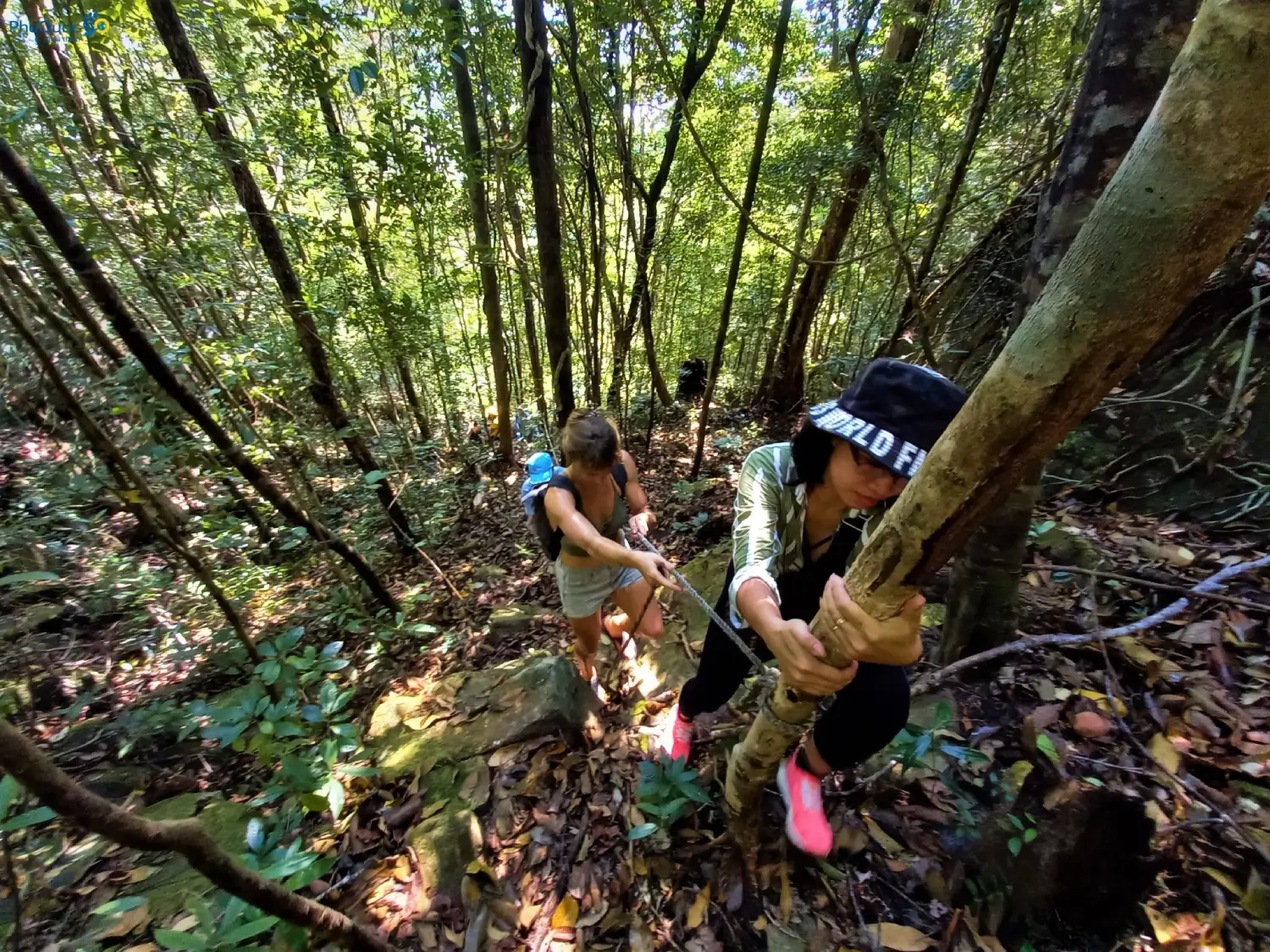
As you gain elevation, the incline gets steeper. You will encounter sections with thick vegetation and surprisingly steep slopes.
- Support points: At some of the trickiest steep sections, previous hikers have tied sturdy ropes to large tree trunks to assist climbing.
- Climbing tips: Test the rope’s firmness before pulling yourself up, always maintain the 3-point contact rule (2 feet 1 hand or 2 hands 1 foot), and step carefully to avoid slippery tree roots.
4. Resting at the “Stone-Trolls” rock area
After about 45–60 minutes of continuous uphill trekking, the incline gradually levels off. The trail veers gently to the left and leads you into an open clearing.
Here stand two giant boulders towering high. We and international trekkers often call this the “Stone-Trolls” area because their shape is reminiscent of the petrified giants in the classic movie The Lord of the Rings. This is a great spot to set down your backpack, catch your breath, and hydrate.
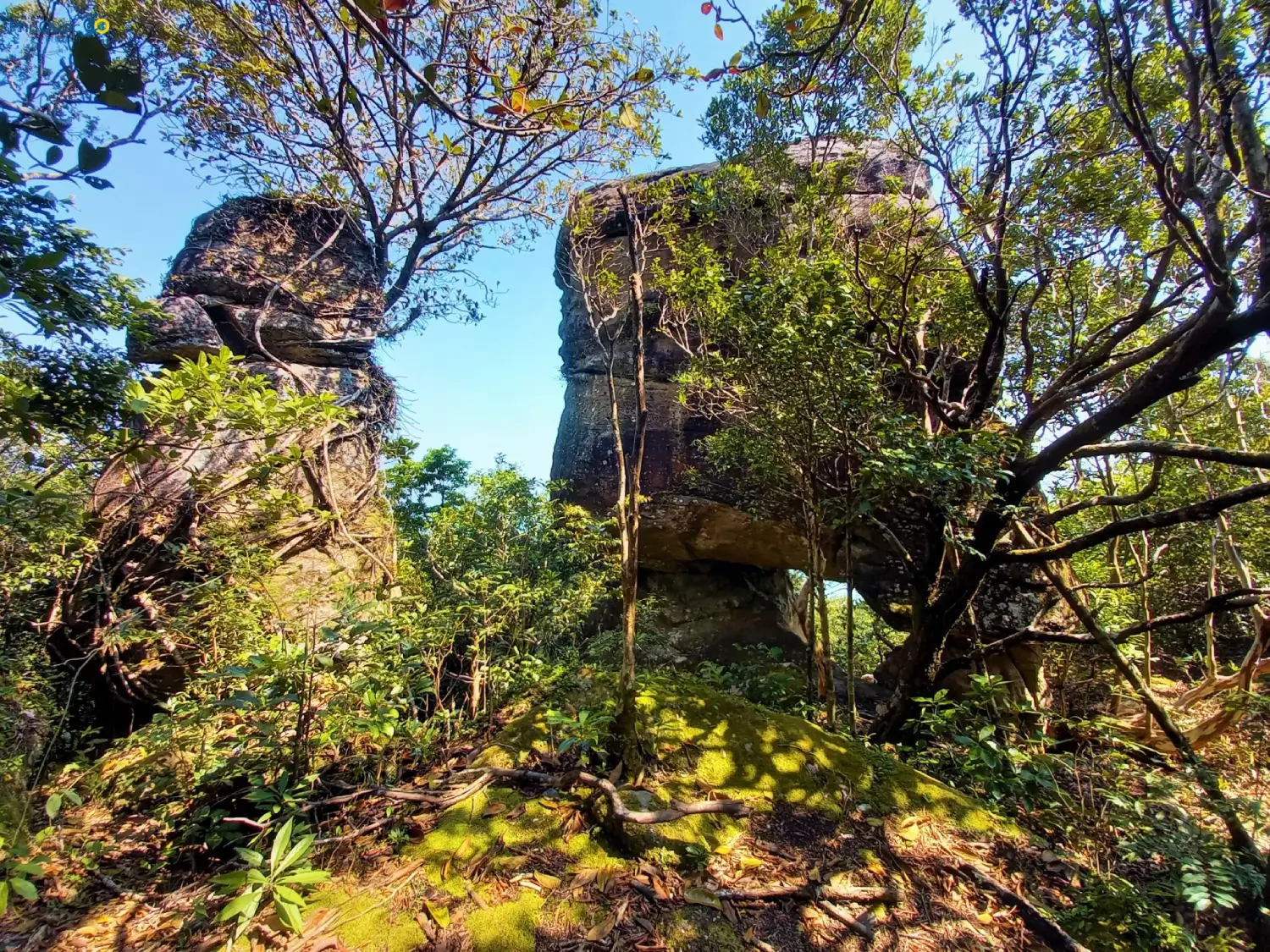
Discovering the 2 Best Viewpoints on Da Bac Peak
Just beyond the two large boulders are the two most valuable viewpoints of the entire journey.
Viewpoint 1: The cliff ledge overlooking Bãi Cây Sao & the East Coast
From the Troll rocks area, turn left and walk a few more minutes through dense bushes to reach a rocky ledge jutting out into open space.
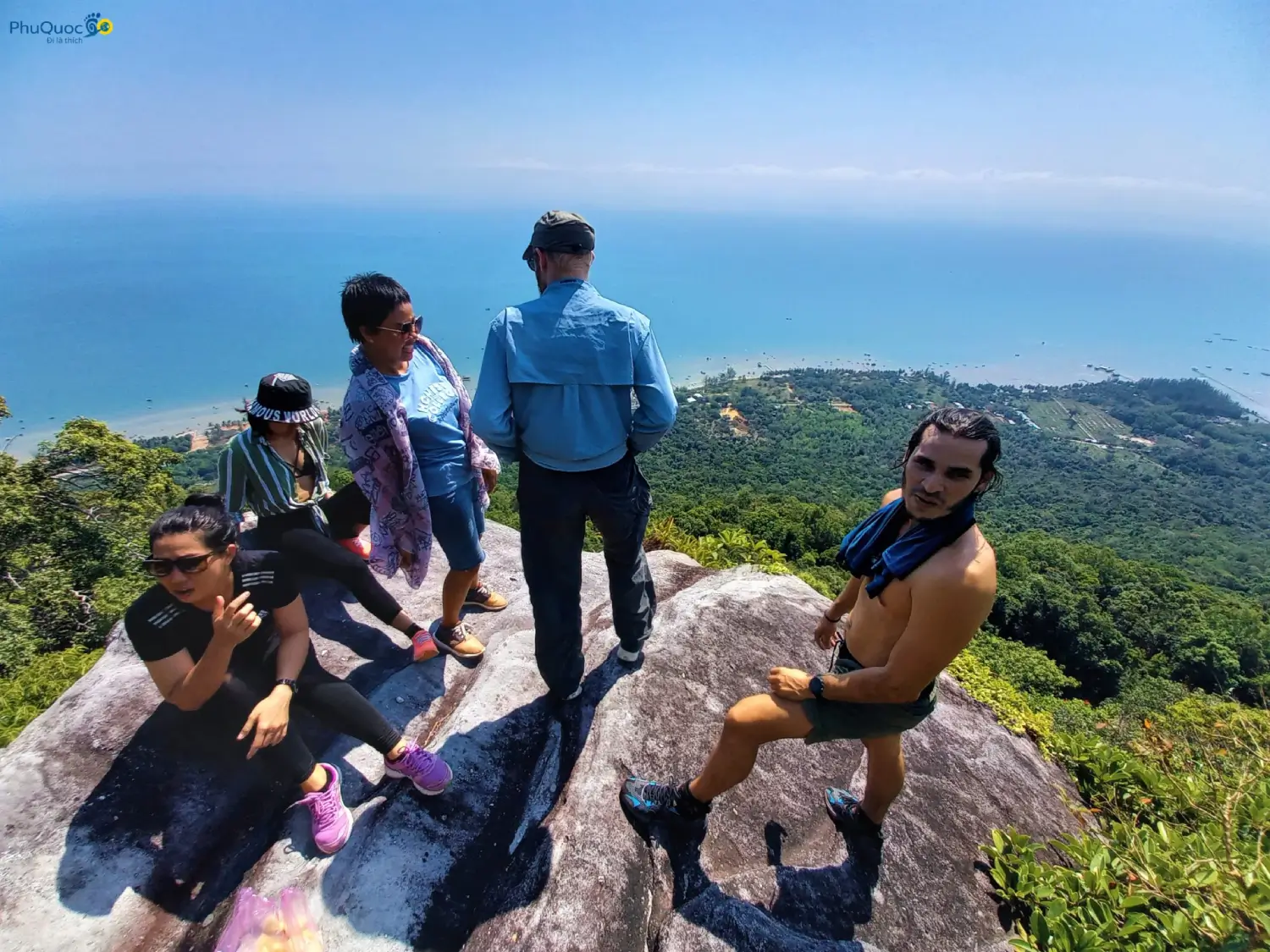
- Multisensory experience: Standing on the cliff ledge, sea breeze blows through the forest canopy carrying a salty tang. In front of you is a vast green carpet of forest stretching down to the resorts of Bãi Cây Sao, with the eastern coastline, Hải Tặc Island, and even the faint Cambodian mainland offshore in the distance.
- Local warning: This rocky ledge is very high and has no protective guardrails. The natural rock surface can be slippery with moss. Absolutely do not stand too close to the edge or jump around taking risky photos. In addition, this spot is somewhat hidden by thickets; if you hike independently without paying close attention, you can easily miss it.
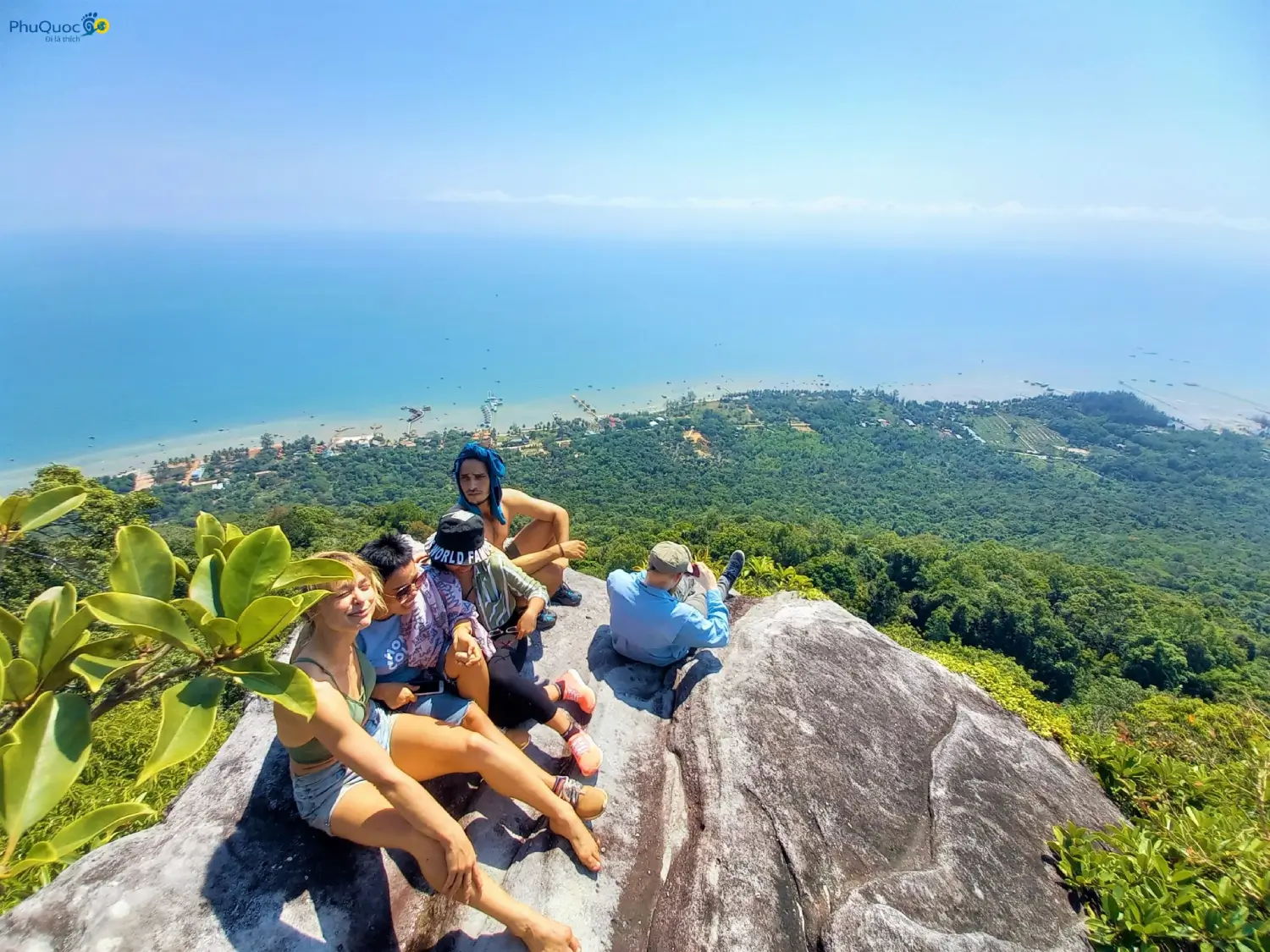
Viewpoint 2: 180-degree view of the inland wilderness & Summit picnic
To reach the second scenic viewpoint, you need to turn back to the two Troll boulders and walk around behind them.
- Crossing the deep gully challenge: The entry path is quite narrow and precarious. You will have to climb up behind a large rock, then cross a makeshift wooden bridge made of tree trunks spanning across a gully about 5 meters deep.
- Life-saving warning: This wooden bridge is extremely risky and can rot over time. If you feel unsafe or suffer from a fear of heights, you should stop and not attempt to cross!
- Ultimate experience: If you cross safely, you will step onto a giant flat rock completely out in the open. The view here opens up nearly 180 degrees toward the north: rolling mountain ranges belonging to the island interior covered in intact green forest canopy, barely touched by urbanization. The space here is exceptionally open and refreshing, perfect for spreading out a mat and having a light picnic with friends before descending.
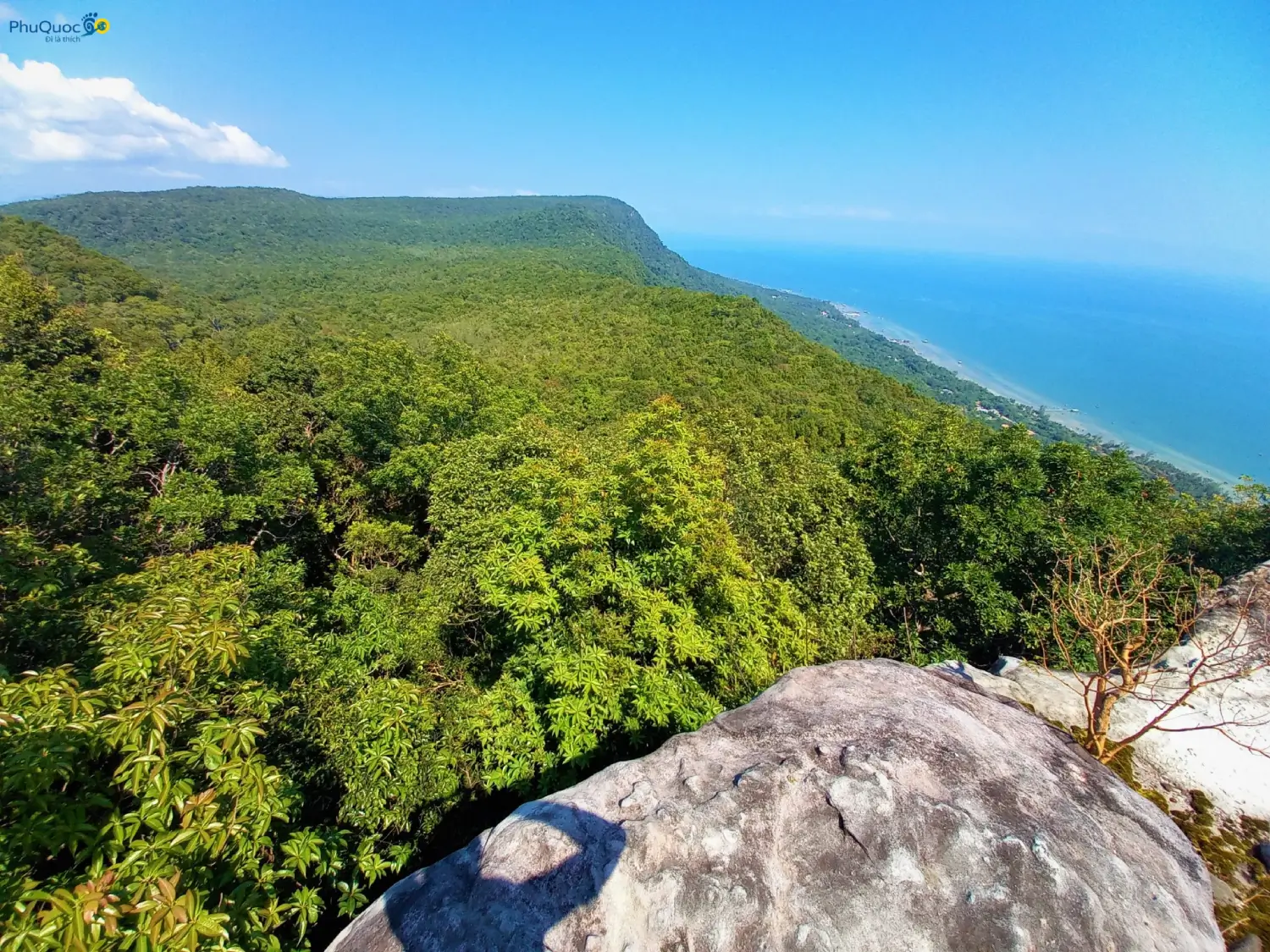
Seasonal Weather Tips for Trekking Da Bac Mountain
To ensure your Phu Quoc trekking trip goes smoothly, checking the Phu Quoc Weather Guide is a decisive factor:
- Dry season (November to May): This is the best time for dry season Phu Quoc trekking. Gentle sunshine, little rain, and a dry forest floor help minimize slipping risks on steep rock sections. Visibility from both viewpoints is also at its clearest and bluest.
- Rainy season (June to October): Rainy season Phu Quoc trekking offers an adventurous sense of accomplishment, but carries many dangers. Downpours make trails slick as grease, rock moss becomes extremely slippery, and mosquitoes and forest leeches are highly active. We strongly advise against hiking independently during this season.
Preparation Guide & Pre-Trip Checklist
To make your Da Bac Mountain Phu Quoc exploration as safe and comfortable as possible, prepare your gear thoroughly following this checklist:
- Trekking/Athletic shoes: Choose shoes with good deep-tread grip. Do not wear flip-flops, sandals, or smooth-soled shoes.
- Drinking water: At least 1.5 liters of fresh water per person (you can bring an extra bottle of electrolyte drink). There are no shops on the mountain.
- Clothing: Stretchy long pants and a lightweight long-sleeved shirt to protect against thick thorns and vines scratching your skin.
- Medicine & Protection: Mosquito/insect repellent spray, sunscreen, basic bandages.
- Light snacks: Energy bars, mixed nuts, chocolate, or fruit to recharge at the peak.
- Trash bag: The golden rule when entering the forest: “Take nothing but pictures, leave nothing but footprints.”
Final Thoughts & Suggested Itinerary for You
Climbing Da Bac Mountain Phu Quoc is not just a stress-relieving workout, but also a journey that lets you feel a pristine, lush, and vibrant side of the Pearl Island. With moderate difficulty and a reasonable timeframe, this is definitely a rewarding change of pace for your trip.
After finishing the hike and descending the mountain, you can combine a visit to famous nearby streams to cool off, such as Suối Đá Ngọn Phú Quốc, Suối Mơ Phú Quốc, or Suối Đá Bàn Phú Quốc.
To plan a more thorough itinerary, check out our article on Phu Quoc Travel Guide from A to Z or explore the list of the Best Trekking Spots in Phu Quoc that we have compiled!
Frequently Asked Questions (FAQ)
Where is Da Bac Mountain Phu Quoc and how do you get there?
Set Google Maps to Ấp Đá Bạc area. As you get close to the base of the mountain, ask local residents for directions to the hiking trail and ask to park your vehicle at a house along the road.
How long does trekking Da Bac Peak take and what is the actual difficulty level?
Ascending from the trailhead to the summit takes about 1h to 1h30m depending on your fitness level. Although the mountain is not extremely high, the incline is quite steep with exposed tree roots and loose rocks, requiring careful footing.
Is there an entrance fee for Da Bac Mountain and do you need to book tickets in advance?
Note: This is a natural area belonging to Phu Quoc's forest mountain system with no ticketing management board. You only pay a small fee to park your motorbike or car at a local home at the base of the mountain.
Do you need a guide for Da Bac Mountain or can you hike independently?
However, the turnoff to Viewpoint 1 is easily hidden by thickets, and crossing the wooden bridge to Viewpoint 2 carries slipping risks. If it is your first time or if you are traveling with children or older adults, we advise hiring a local guide for safety.
Is climbing Da Bac Mountain dangerous? What warnings should you keep in mind?
Viewpoint 1 is a cliff ledge protruding over a drop without protective guardrails and can be mossy and slippery during the rainy season. Stand back from the edge when taking photos and avoid risky climbing on sharp rock formations.
Is the makeshift wooden bridge to Viewpoint 2 at Da Bac Mountain safe?
Before stepping across, test the firmness of the wood. If you feel the logs are rotten, slippery, or if you have a history of vertigo or fear of heights, stop and rest at the two Troll boulders instead of trying to cross.
What season is best and least risky for trekking Da Bac Mountain?
During this season, the weather is dry, the forest interior is cool, and the firm ground provides good shoe traction. Avoid hiking during the rainy season (June to October) due to slippery mud trails and forest leeches.
What personal items do you need to prepare for climbing Da Bac Mountain Phu Quoc?
Mandatory checklist: At least 1.5L of drinking water per person, athletic or trekking shoes with good tread grip, insect spray, sunscreen, light snacks (energy bars, mixed nuts), and a personal trash bag.