

Are you planning a trip to find the bright sea breeze on the Pearl Island, wanting to see with your own eyes the sunset falling over the horizon that everyone raves about? But amid a jungle of online information, are you worried about the crowds, wondering what time is best to go, where to park your vehicle without being ripped off, or how to eat around the center of Duong Dong for authentic local flavors at reasonable prices?
We clearly understand those worries of yours. With more than 6 years of operating tours and accompanying thousands of guests, we wrote this review Dinh Cau Temple Phu Quoc to bring you the most honest and complete perspective. This article will help you master everything from directions, spiritual history, and tips to catch the bright red sunset glow, to an itinerary combining endless fun without spending a single dime on admission tickets.
Dinh Cau Temple is located right in the city center, but if you do not know how to go, you can easily be overwhelmed by the number of visitors flocking here in the late afternoon, or choose the wrong time, cutting your experience in half. Let’s explore this “sacred rock” right below with us!

Where is Dinh Cau Temple? Detailed Address and Directions to Dinh Cau Temple
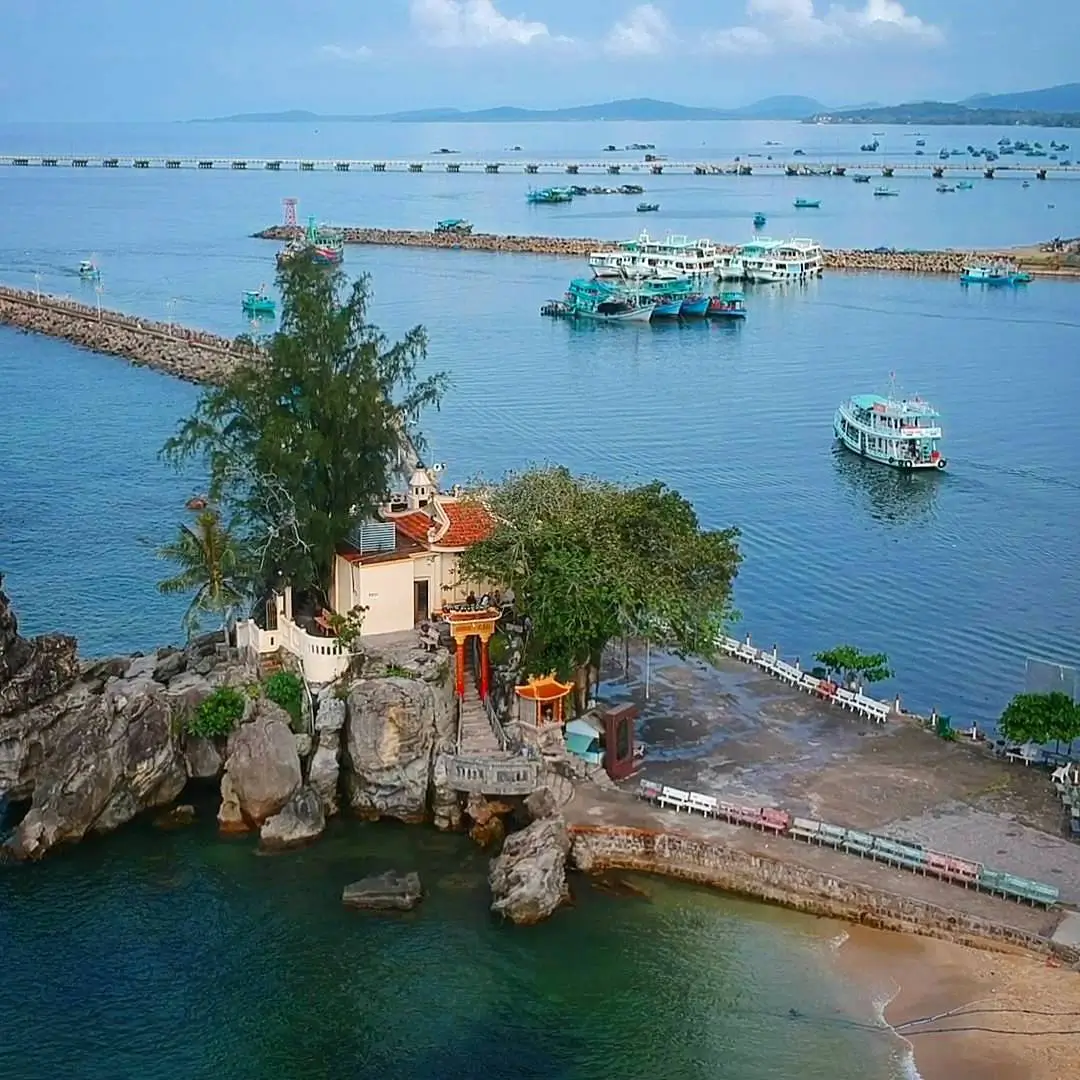
Standing proudly on a natural rocky cliff facing directly toward the West Sea, Dinh Cau Duong Dong has long been an inseparable symbol of the beach city. If you are wondering about the specific address of Dinh Cau Temple Phu Quoc, this place is located in Quarter 2, Duong Dong Ward, Phu Quoc City, An Giang Province.
The location of the temple is extremely prime: only about 200m west of the center of Duong Dong, situated right next to the mouth of the Duong Dong River, and it takes only about a 3-minute walk for you to reach the Phu Quoc Night Market area.
To help you easily visualize and plan your itinerary, we have quickly summarized the practical information table below:
| Criteria | Detailed Information | Local Notes |
| Address | Quarter 2, Duong Dong Ward, Phu Quoc, An Giang | Right at the mouth of the Duong Dong River, next to the old boat pier. |
| Dinh Cau Temple Opening Hours | 7:00 AM – 8:30 PM daily | You should arrive before 5:00 PM to both worship and catch the sunset in time. |
| Is there an entrance fee for Dinh Cau Temple? | Completely FREE | No organization collects entrance tickets, please keep this in mind. |
| Distance | About 200m from Phu Quoc Night Market | A very short walk away, making it highly convenient to combine with evening plans. |
Guide to the Fastest Route to Dinh Cau Temple
The path here is extremely simple, whether you choose the option to rent a motorbike in Phu Quoc for absolute freedom or take a tech taxi. From the main road Tran Hung Dao, you only need to turn into Vo Thi Sau Street, drive straight to the end of this road, and the sacred rock with the ancient moss-roofed shrine will appear right before your eyes.
History of Dinh Cau Temple and Thrilling Legends from a Local Perspective
Not just a Dinh Cau Temple check-in spot with a million-dollar ocean view, this place also carries a deep flow of culture and beliefs of the islanders through more than 300 years of ups and downs.
Formation History and Restoration Milestones
According to ancient documents and stories from elders, the history of Dinh Cau Temple began around the 17th century (estimated in 1673). Initially, the shrine was just a small, simple hut made of thatch and leaves, tucked under the canopy of an ancient forest tree.
- July 14, 1937: The temple was rebuilt solidly with poured cement by local residents joining hands to withstand ocean storms.
- July 14, 1997: The temple was restored to be more spacious and grand, but the overall architecture and ancient, solemn features have been preserved intact to this day.
Who is Worshipped at Dinh Cau Temple and Its Deep Spiritual Significance
When entering the main hall, you will see that this place worships Chúa Ngọc Nương Nương (Bà Chúa Thủy – the goddess protecting the waters, rooted in Mother Goddess worship and intersecting with the Cham deity Po Ino Nagar) along with the altar displaying statues of the two Lords, Cậu Tài and Cậu Quý. For local fishermen, these deities are the ultimate spiritual anchor. Before each long fishing trip, they come here to light incense, praying for calm seas and boats full of fish.
Correction corner from tour experts: Many articles often confuse the legend of King Gia Long (Nguyen Anh) escaping the Tay Son, planting his sword to find fresh water (Giếng Ngự) at Dinh Cau Temple. In reality, historical researchers have confirmed that this event took place at Mũi Ông Đội, more than 15km as the crow flies south of Dinh Cau Temple. This confusion is mainly due to folklore word-of-mouth; please note this detail to have the most accurate view!
Dinh Cau Temple Festival – The Beauty of Island Culture
If you are lucky enough to visit the Pearl Island on the 15th and 16th days of the 10th lunar month every year, you will be immersed in the Dinh Cau Temple festival. The festival includes solemn sacrificial ceremonies following ancient rituals and festive activities with lively folk games by fishermen. Every year, this occasion combined with Lunar New Year attracts more than 100,000 visitors flocking here, creating an extremely exciting atmosphere.
What to See When Visiting Dinh Cau Temple? A Multi-Sensory Experience at the Sacred Rock
When arriving to visit Dinh Cau Temple, the first experience touching your senses is the sound of rustling waves echoing against the cliffs, blending with the scent of agarwood incense drifting in the salty sea breeze.
To reach the main hall, you will walk up 29 stone steps curving gently between two natural rock crevices. Along the way, you will come across a small, quiet Thổ Thần shrine. Reaching the sturdy cement-paved courtyard, you will see the Ông Thiên altar and an ancient gách tree over a century old, spreading its wide green canopy across all four seasons to provide shade for the entire temple.

The architectural highlight reflecting the typical ancient Southern shrine style of Dinh Cau Temple lies in the system of parallel sentences and horizontal lacquered boards arranged very solemnly. If you take the time to observe every corner like a true local “thổ địa”, you will see a very interesting cultural intersection through each line of characters:
- On the cement columns outside the main corridor (facing the sea): This is where parallel sentences are embossed in Chinese characters, carrying a deep layer of meaning about the sacred land and the divine responsiveness of the deities:
- “Tọa đại thạch đầu quy danh hiển” (The temple is famous for being located right on top of a rock shaped like a divine turtle).
- “Vạn cổ anh linh thông tứ hải” (Since ancient times, the sacred spirit and protection of Cau have been renowned across the four seas).
- On the side wall of the entrance close to the main hall (right at stone step number 29): You will come across a Four Seasons bas-relief (Pine – Bamboo – Chrysanthemum – Plum) embossed with very vivid colors. The unique point lies in the two parallel boards on the sides; at first glance, they look like Chinese characters, but they are actually chữ Quốc ngữ written in a stylized, archaic style extremely cleverly, expressing the eternal aspirations of the Pearl Island fishermen:
- Left phrase: “Phong điều vũ thuận dân an lạc” (Favorable rain and harmonious wind make people happy and peaceful, reducing their hardships).
- Right phrase: “Hải yến hà than thiên hạ bình” (Petrels flying back signal calm seas and clear rivers, from which the world finds peace and stability).


The front of the main hall faces straight out to the vast ocean, and on top of the moss-covered tiled roof is the intricate green glazed porcelain icon of “two dragons fighting for a pearl,” standing out against the deep blue sky.


Experience Watching the Sunset at Dinh Cau Temple: Which Time of Day Is Best?
If someone asks us what time is best to visit Dinh Cau Temple, the answer is definitely from 4:30 PM to 6:00 PM. This is the time for watching the sunset at Dinh Cau Temple – a “specialty” that no travel enthusiast should miss when visiting Phu Quoc.
As the sun gradually retreats toward the horizon, the entire Duong Dong sky looks like a palette of a genius painter: shifting from lemon yellow, bright orange, and then fading into a dreamy deep purple. The evening glow illuminates the undulating rocks, reflecting off the fishing boats anchored near the river mouth, creating a breathtaking scene.

- Photography tip from locals: Instead of standing crowded right in the temple courtyard, walk down to the stone embankment below the base of the temple (near the adjacent Lăng Ông Hải Nam area). The view from the bottom up allows you to capture the panoramic view of the ancient shrine on the rocky cliff while catching the bright sky behind it without worrying about getting other people into your frame.

Objective Evaluation: Pros & Cons When Visiting Dinh Cau Temple
To give you a realistic view and the best mental preparation, we, as long-time tour operators, would like to frankly share the plus points and points to note here:
Plus Points (Pros)
- Location right in the center, extremely easy to find and travel to, saving time.
- Completely free admission, no sightseeing costs.
- The West Sea sunset view is among the top best on the island, with a breezy space.
- Sacred historical and spiritual value, helping to understand the fishermen’s life more deeply.
Minus Points to Note (Cons)
- Fairly small area: During peak sunset hours (5:00 PM – 5:30 PM), the volume of visitors flocking here is very large, making the temple courtyard space easily feel stuffy and noisy.
- Slightly steep stone steps: Although there are only 29 steps, if your group includes elderly people with weak knee joints or active children, you need to stay close and hold onto the handrail carefully.
- Solicitation for parking around the outer area: Some spontaneous beverage stalls outside may wave down guests to park and then force them to buy drinks at high prices.
Preparation Guide & Perfect Duong Dong and Night Market Combined Itinerary
To make your independent trip as smooth as a local’s, save this pocket guide from us right away:
- Attire: Since this is a solemn spiritual place of worship, you should choose polite, conservative clothes (sleeved shirts, pants or skirts covering past the knees) when entering the main hall. If you want to take flowing photos with the sea, you can bring a light shawl to wear outside during the ceremony, then take it off when out on the stone corridor to pose for photos.
- Phu Quoc weather notice: Phu Quoc is divided into two distinct seasons. In the dry season (November to April of the following year), the sea is calm, the sun is beautiful, and traveling is very suitable. Conversely, if you go during the rainy season Phu Quoc weather (May to October), the Dinh Cau Temple rocky area often has large waves crashing violently against the shore. At this time, absolutely do not step onto the slippery rock edges to take photos, as it is very dangerous.

Suggested Afternoon – Evening Itinerary in Duong Dong
If you are planning a Phu Quoc 3 days 2 nights itinerary, dedicate an afternoon and evening to the center of Duong Dong according to the super smooth route below:
4:00 PM: Depart from the hotel, check-in, and visit Dinh Bà Thủy Long Thánh Mẫu not far away.
4:45 PM: Arrive at Dinh Cau Temple, light incense to pray for peace, then move down to the stone embankment to watch the bright sunset and take pictures.
6:30 PM: Stroll about 3 minutes to the Phu Quoc Night Market, freely devouring specialty dishes like bún quậy, grilled seafood, rolled ice cream, bánh khọt… ending a complete evening.

Conclusion
Dinh Cau Temple is not merely a scenic landscape; it is the soul, the place holding the courageous stories of the people tied to the Pearl Island sea for centuries. Coming here, standing in front of the breezy open sea, watching the last ray of sunlight fade at the end of the day, you will feel a very different Phu Quoc – peaceful, deep, and nostalgic amidst the modern tourism flow.
If you want to combine your Duong Dong trip with untamed experiences on the small southern islands, do not hesitate to check out our Phu Quoc 3 islands tour for the most complete and safe journey!
Frequently Asked Questions About Dinh Cau Temple Phu Quoc (FAQ)
Does Dinh Cau Temple Phu Quoc charge an entrance or sightseeing fee?
Any offers to sell "tickets to the temple" from strangers around are scams. You can confidently walk straight up the stone steps to enter the shrine without needing to show any documents or money.
Where should I park my motorbike when going to Dinh Cau Temple to avoid being overcharged?
Be vigilant with people enthusiastically waving from afar in front of spontaneous beverage stalls on Vo Thi Sau Street. If you park your vehicle there, they usually force you to buy soft drinks or fresh coconuts at sky-high prices before letting you take your vehicle out.
Can children and elderly people walk up to visit Dinh Cau Temple on their own?
Although there are few steps, the walkway is a bit narrow and the natural stone steps can be slightly uneven. If traveling with active young children, remember to hold their hands tightly, avoiding letting them climb out toward the cliffs near the water's edge, which is very dangerous.
What dangerous things should be noted when visiting Dinh Cau Temple during the rainy season (May – October)?
The West Sea waves this season beat very violently against the Dinh Cau Temple cliffs, blowing white foam and creating a slippery layer of moss on the rocks. It is best that you only stand from the high, dry temple courtyard to observe and take photos; do not risk stepping down to the rocky shore close to the sea.
Are there any tourist traps around the Dinh Cau Duong Dong area that need to be avoided immediately?
Those night squid fishing tickets sold on the street for a few tens of thousands are usually just shuttle transfers taking you to dilapidated rafts that do not guarantee safety. If you want to experience squid fishing, please book through reputable travel companies with clear travel insurance.
How should I dress when going to Dinh Cau Temple to be both polite and have beautiful photos?
A small tip for women is to wear a long, flowing maxi dress to take ocean photos outside the corridor, but bring along a large silk scarf to cover your shoulders when stepping inside to light incense in the temple.
Can I combine a trip to Dinh Cau Temple with other spots in the same afternoon?
These three locations are situated right next to each other within a radius of less than 500m. You should park your vehicle at the Dinh Cau Temple parking lot starting from 4:30 PM, walk around for sightseeing, and then head to the night market to eat, avoiding having to move your vehicle in and out of the lot multiple times, which can be tiring.
On which days does the Dinh Cau Temple Festival take place, and can tourists participate?
On this occasion, the atmosphere in Duong Dong is extremely lively with palanquin processions, pot-breaking games, coracle racing... If you happen to visit during this time, you should walk early because all routes leading to the shrine will be blocked to serve the festival, and the crowd flocking in will be overwhelming.