Planning a trip to Phú Quốc and looking for a quiet, historic space amid countless busy entertainment spots? Wondering where Su Muon Pagoda is located, whether the mountain road is difficult to drive, or what the real story is behind its centuries-old kơ nia tree?
Drawing on years of guiding travelers along every road of the Pearl Island, we will answer all your questions in detail in this guide. This article offers an honest look at Hùng Long Tự (Su Muon Pagoda Phu Quoc), covering its historical origins, mountainside architecture, the truth about the kơ nia tree, and practical transportation tips to make your visit smooth and peaceful.
Why Is Hùng Long Tự (Su Muon Pagoda) Worth Visiting in Phú Quốc?
Amid the rapid growth of modern entertainment complexes, many travelers visiting the Pearl Island feel overwhelmed by man-made structures and miss a genuine sense of relaxation. Finding a spiritual destination that feels both sacred and surrounded by rustic nature is not always easy if you only skim brief promotional pages.
In addition, online information about Hùng Long Tự (Su Muon Pagoda) is currently fragmented and often inaccurate regarding opening hours, the age of the ancient tree, and its founding history. Reading this guide carefully will help you plan your schedule, dress appropriately, and appreciate the local cultural value rather than just stopping by for a quick photo.
Where Is Su Muon Pagoda Phu Quoc? Directions and Opening Hours
Location and Distance from Dương Đông
Hùng Long Tự is located at its current administrative address: Suối Đá Hamlet, Phú Quốc Special Zone, An Giang Province (effective July 1, 2025, under Resolution 1654/NQ-UBTVQH15). The pagoda backs up against the mountainside along the main road connecting Dương Đông and Hàm Ninh, about 5 km east of central Dương Đông. If you are planning an itinerary around top attractions in Dương Đông, this is an extremely convenient stop.
How to Get There and Route Up to the Pagoda
From the town center, follow Road ĐT45 toward Hàm Ninh. When you see the directional sign for the Suối Đá area, turn toward the three-entrance gate (cổng tam quan) at the foot of the mountain.
- Concrete mountain road: Stretching about 800 m, this road winds around the green, shaded mountainside. It is wide enough for both motorbikes and 16-to-29-seat tour buses to pass easily.
- Walking up to the main hall: Once you reach the parking area, you need to climb 60 stone steps to enter the main hall courtyard. The steps are not too steep, though you should walk slowly to enjoy the fresh air. For flexible transportation throughout your trip, check out our Phú Quốc motorbike rental guide for affordable options.
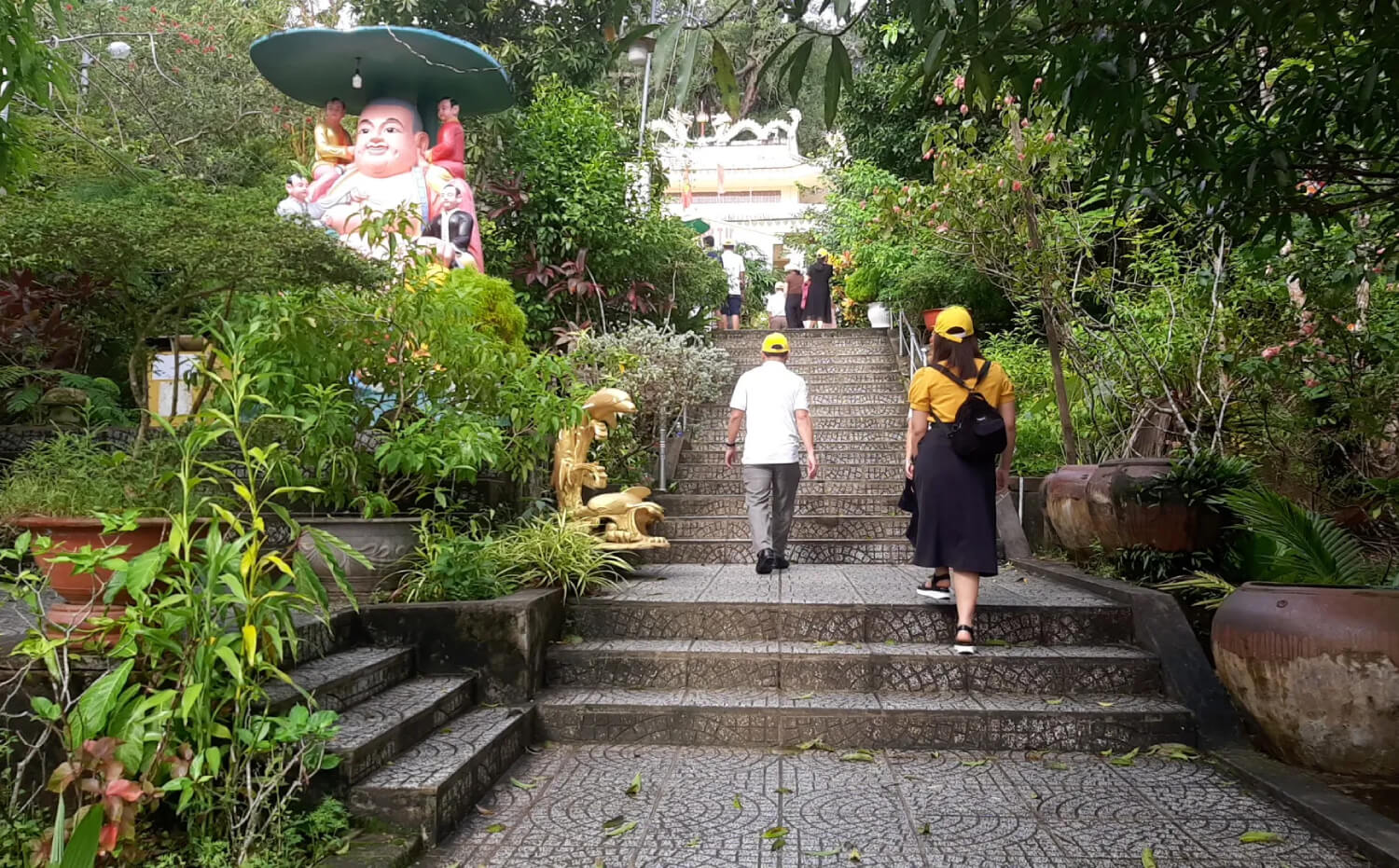
Central Dương Đông ➔ Road ĐT45 (toward Hàm Ninh) ➔ Three-Entrance Gate at the mountain base ➔ 800m concrete road ➔ Parking lot ➔ 60 stone steps ➔ Hùng Long Tự Main Hall
Admission Fees and Opening Hours
- Admission fee: Completely free. The pagoda does not charge any entrance or sightseeing fees.
- Opening hours: Some travel sources list daily hours from 6:00 AM to 6:00 PM. However, the pagoda has not posted an official fixed schedule. We recommend visiting between 7:00 AM and 10:00 AM or 2:30 PM and 4:30 PM for the coolest air and to avoid harsh sunlight while climbing the steps.
History of Hùng Long Tự and Zen Master Giai Minh
The Founder and the 1932 Establishment
Construction of Hùng Long Tự began in 1932 under its founder, Zen Master Giai Minh. His secular name was Nguyễn Kim Muôn, born in 1892 in Bình Hòa, Gia Định. Before becoming a monk, he worked as an accountant at the Bank of Indochina. The name “Chùa Sư Muôn” or “Chùa Sư Môn” (Su Muon Pagoda) comes from the local residents’ respect for his birth name.
Before settling in Suối Đá, Zen Master Giai Minh traveled to spread Buddhist teachings on Hòn Thơm and Thổ Chu islands. Drawn to the quiet of the Suối Đá mountains, he built a simple pagoda out of wood and thatched leaves to practice Buddhism and prepare herbal medicine for locals. The founding of this Pure Land Lay Buddhist (Tịnh Độ Cư Sĩ) pagoda is a meaningful piece of the broader history and development of Phú Quốc.
Wartime Hardships and Restoration
In 1945, due to the impact of war, the wooden and thatched pagoda was heavily damaged. Zen Master Giai Minh and the monks had to temporarily leave the pagoda and reside at Tổ đình Long Vân.
After Zen Master Giai Minh passed away (historical records differ on the exact year, with some citing 1946 and others 1955), Venerable Minh Úc was tasked with returning to Phú Quốc to gradually restore the pagoda. From 1999 to 2001, the pagoda underwent a major renovation lasting over two years, expanding the grounds and rebuilding the sturdy main hall and stupa seen today.
Architecture and Peaceful Mountain Scenery
The Three-Entrance Gate and Main Hall (Đại Hùng Bảo Điện)
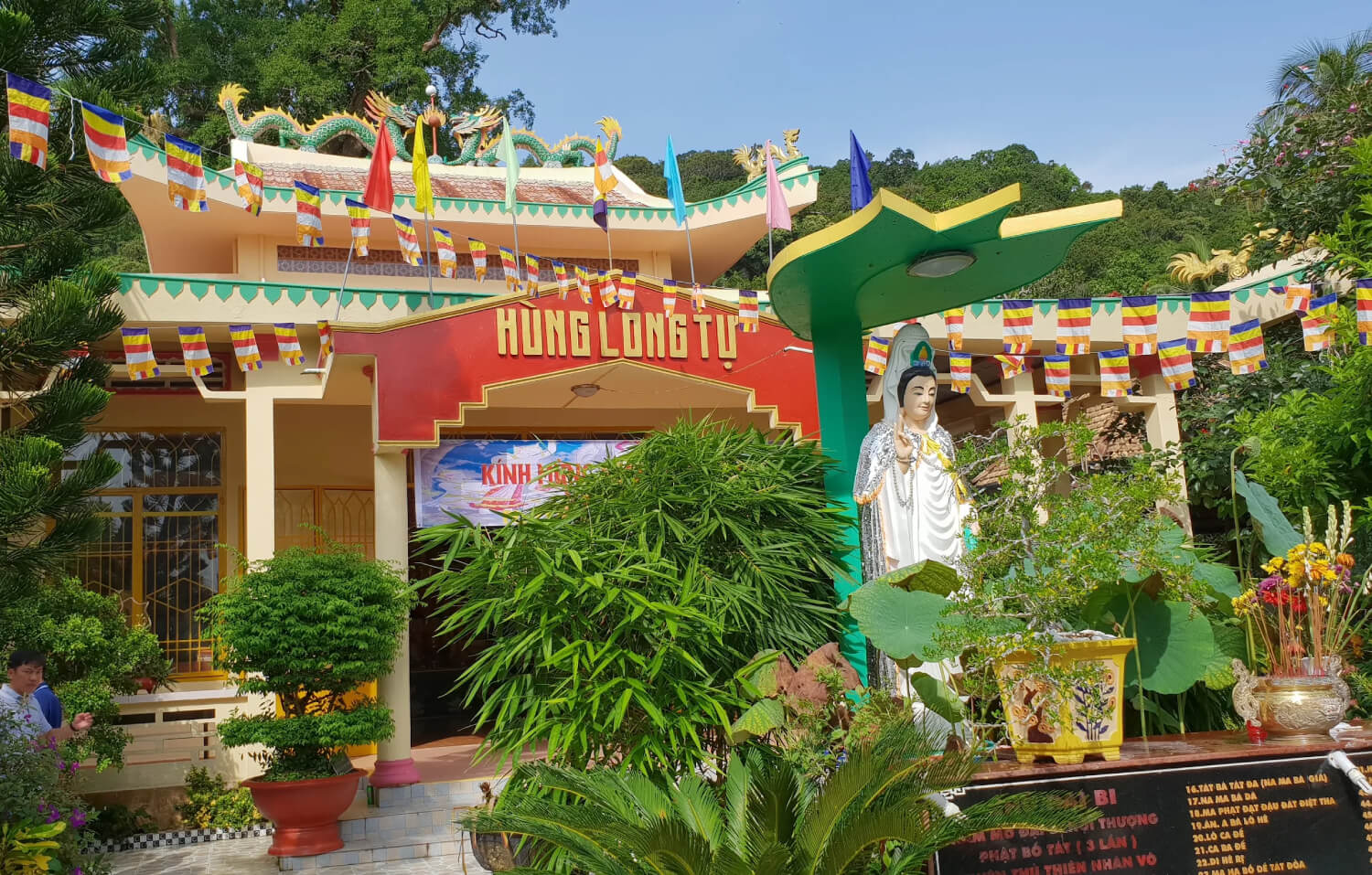
Right at the foot of the mountain, the three-entrance gate (cổng tam quan) features traditional Buddhist architecture with curved roofs, intricate dragon and phoenix carvings, and a prominent nameplate reading “Hùng Long Tự.”
After climbing the 60 stone steps to the main courtyard, you will see a statue of Maitreya Buddha (Phật Di Lặc) with a joyful smile, surrounded by figures of young novices symbolizing peace and prosperity. Inside Đại Hùng Bảo Điện (the Main Hall), a solemn sanctuary houses a large central statue of Shakyamuni Buddha (Phật Thích Ca Mâu Ni), flanked and backed by statues of Amitabha Buddha (Phật A Di Đà), Avalokiteshvara Bodhisattva (Quán Thế Âm Bồ Tát), and Mahasthamaprapta Bodhisattva (Đại Thế Chí Bồ Tát).
Local insight: Standing in the courtyard in front of the main hall and looking out, you will see endless forest surrounding the grounds. The faint scent of incense blends with the aroma of morning dew on forest leaves, creating a calming atmosphere that helps clear your mind.
Meditating Shakyamuni Buddha Statue Behind the Pagoda
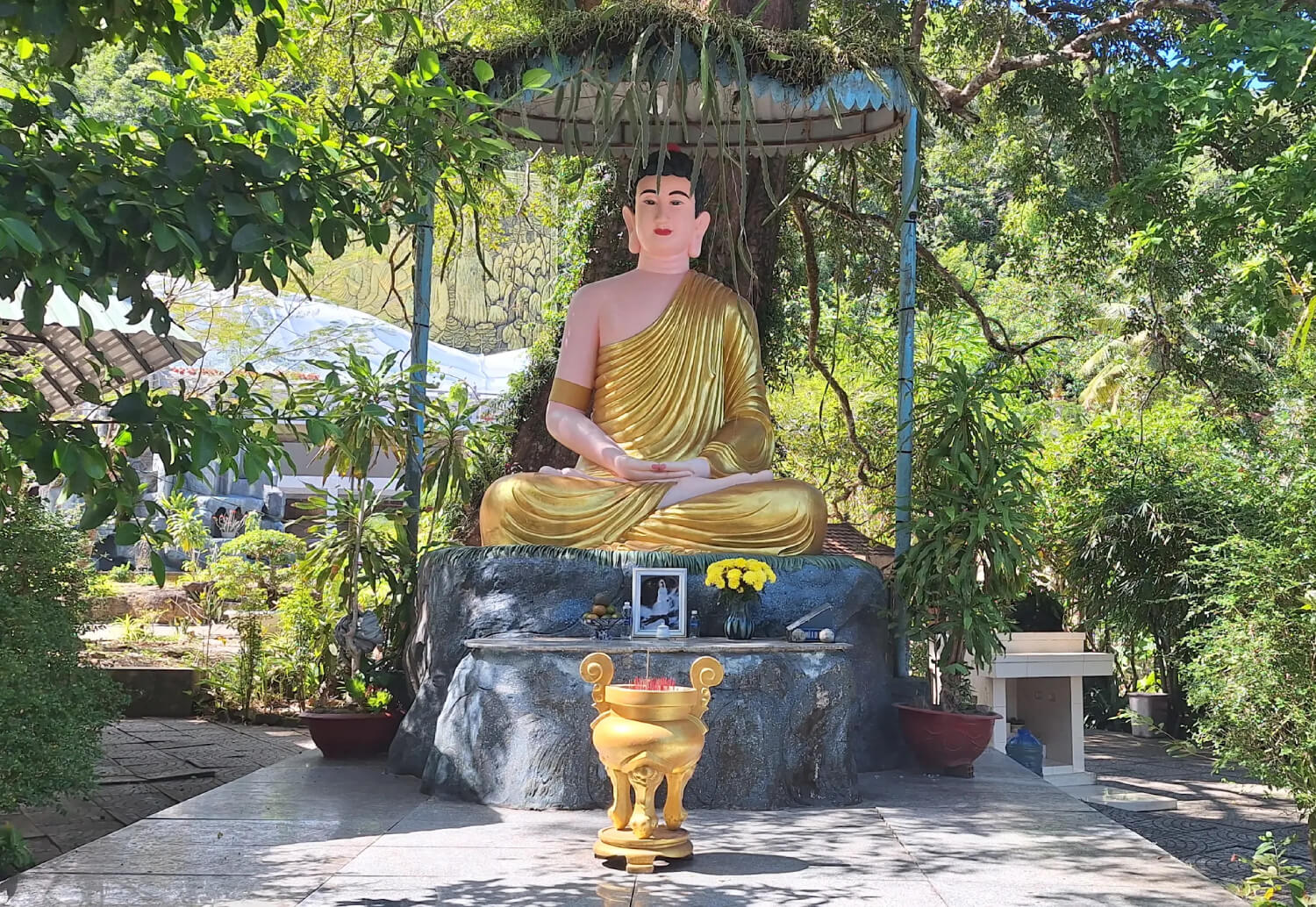
Walking around to the area behind the main hall, you will come across an especially quiet spot: a statue of Shakyamuni Buddha meditating beside an ancient bodhi (bồ đề) tree, backed by the mountainside and primary forest. Many visitors come here to quiet their minds, meditate briefly, or simply sit in silence listening to birdsong in the woods.
The Truth About the Ancient Kơ Nia Tree at Su Muon Pagoda
Impressive Physical Characteristics
The kơ nia tree growing right inside the pagoda grounds is a striking natural landmark. Standing about 40 m tall, it has wide buttress roots and a massive trunk that takes roughly 10 people linking arms to encircle. Based on local observation, the tree typically sprouts new leaves in spring and begins bearing fruit around the third lunar month.
Fact-Checking the Tree’s Age
Over the years, various claims about the age of this kơ nia tree have circulated across travel channels:
- Some sources state that the tree is around 200 to 300 years old.
- Local folklore and estimates from the abbot suggest the tree has lived for nearly 800 years.
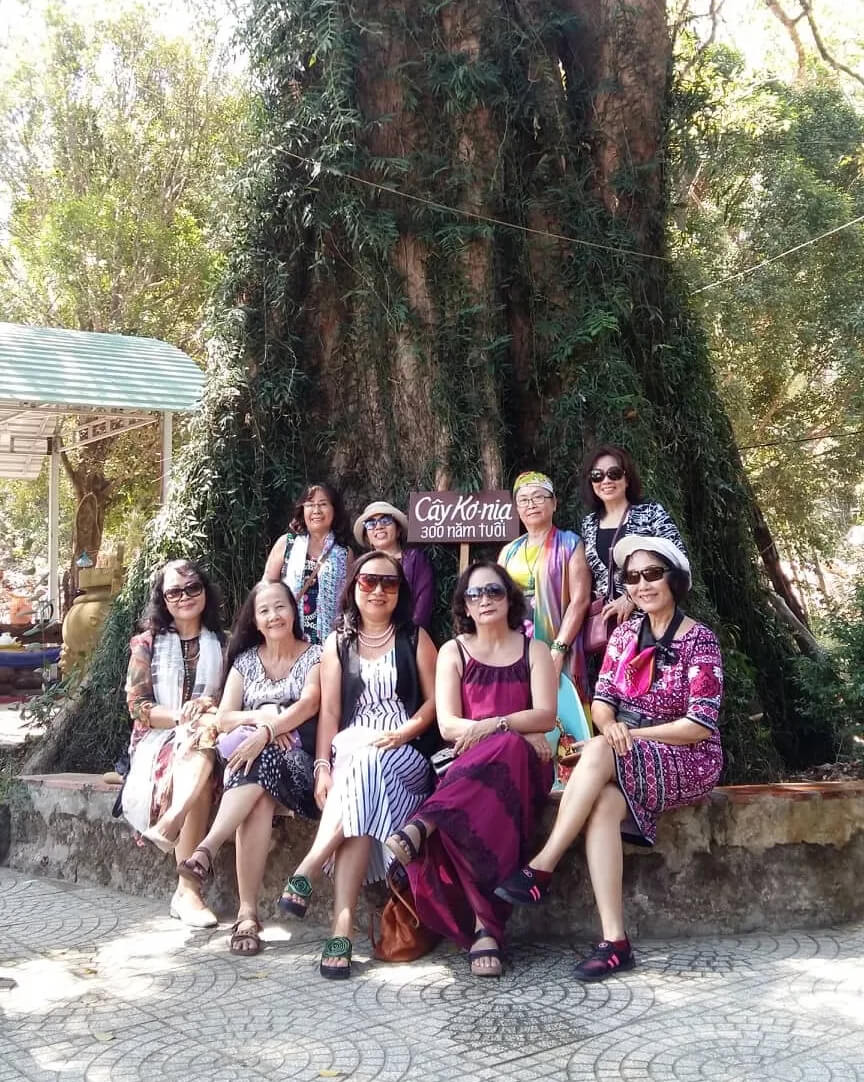
Local note: Currently, there is no independent scientific testing confirming the exact age of this kơ nia tree. Locals refer to it as a “centuries-old kơ nia tree” mainly because of its massive size and long association with the pagoda’s history. It is best to appreciate this detail as part of local cultural lore rather than an exact scientific fact.
Comparing Hùng Long Tự with Other Spiritual Sites in Phú Quốc
To help you plan your itinerary easily, we put together an objective comparison between Hùng Long Tự and two other well-known spiritual sites on the island:
| Criteria | Hùng Long Tự (Su Muon Pagoda) | Hộ Quốc Pagoda (Trúc Lâm Zen Monastery) | Dinh Cậu |
| Location | Suối Đá mountainside (near Dương Đông) | Southern island (Dương Tơ Commune) | Right at the river mouth in central Dương Đông |
| Atmosphere | Secluded, quiet, shaded by dense forest | Grand, ocean-facing, very spacious grounds | Historic, sound of crashing waves, great sunset views |
| Highlights | History dating back to 1932, ancient kơ nia tree, 60 stone steps | Massive ironwood architecture, panoramic ocean views | Fishermen’s folk shrine, dramatic rock formations |
| Crowd Level | Moderate – Quiet | Very crowded with tour groups | Very crowded around sunset |
| Best For | Travelers seeking peace and local history | Visitors who enjoy large-scale scenic photography | Visitors interested in local shrines and sunset views |
If you have time, consider visiting all three sites. Read our Hộ Quốc Pagoda visiting guide and explore Dinh Cậu – the famous shrine in Dương Đông for a fuller perspective.
Preparation Checklist & Local Tips
- Dress code: Because this is an active place of worship, modest clothing is required (sleeved shirts and pants or skirts that cover the knees).
- Footwear: Opt for sneakers or strapped sandals with good grip. Climbing the 60 stone steps and walking on the mountainside can be slippery in high heels or thin flip-flops.
- Note for families: If your group includes older adults with joint pain or very young children, walk slowly and take breaks on the intermediate landings.
- Respect the grounds: Do not pick flowers, break branches, or litter, and strictly do not carve names or write on the trunk of the ancient kơ nia tree or on the rocks around the pagoda.
- Suggested route combination: You can visit Hùng Long Tự in the morning, then travel about 3 km farther to explore Suối Tranh Waterfall in Phú Quốc, before stopping for lunch and seafood in the old fishing village of Hàm Ninh. This route fits naturally into a 3-day, 2-night Phú Quốc itinerary.
Final Thoughts
Hùng Long Tự (Su Muon Pagoda) is more than a quiet temple tucked into the slopes of Suối Đá Mountain; it preserves Buddhist history dating back to 1932 and the legacy of Zen Master Giai Minh. The fresh air, shaded kơ nia tree, and calm atmosphere offer genuine rest after busy days.
If you are looking for nature-focused, crowd-free Phú Quốc tours that combine local cultural sites with exploring the South or North Island, reach out to our tour operations team for a detailed itinerary and cost-effective options!
FAQ – Frequently Asked Questions About Su Muon Pagoda Phu Quoc
Is there an entrance fee for Su Muon Pagoda Phu Quoc?
The pagoda does not charge any fees for admission or parking. If you wish to make a donation for pagoda maintenance, you can place your contribution directly into the designated donation boxes inside the main hall.
Is the road up to Hùng Long Tự difficult, and can cars drive up?
The road up the mountain is smoothly paved, making it easily accessible for 4-to-29-seat vehicles. From the parking lot to the main hall, you must climb 60 stone steps. Older visitors or those with limited mobility should walk slowly and have someone accompany them.
What are the exact opening hours of Su Muon Pagoda Phu Quoc?
The best times to visit are 7:00 AM – 9:30 AM or 3:00 PM – 4:30 PM. Avoid visiting around midday (11:30 AM – 1:30 PM), as this is the monks' rest period and the sun on the stone steps can be quite harsh.
How old is the kơ nia tree at Su Muon Pagoda?
Figures of 200, 300, or 800 years are based mainly on local folklore and estimates from the abbot. Even without a scientifically verified age, its massive trunk—requiring 10 people to encircle—and 40m height make it an impressive natural sight.
What dress code and etiquette rules apply when visiting Hùng Long Tự?
Required attire: Sleeved shirts and pants or skirts extending below the knee. Avoid spaghetti straps, tank tops, or short shorts. Etiquette: Walk quietly, speak softly, do not play music on external speakers, avoid taking direct photos of people praying or offering incense, and never carve anything into the kơ nia tree trunk.
Which nearby attractions can be combined with a visit to Su Muon Pagoda?
Optimal route: Visit Hùng Long Tự in the morning ➔ Explore Suối Tranh Waterfall ➔ Have a seafood lunch in Hàm Ninh. This entire route runs along Road ĐT45, saving travel time and fuel costs.